
What manner of five travellers are these, whose carriage, in the dark hour of evening, draws up before a low, one-storeyed house of stone, standing at the crossing of the two principal streets of Ratedorf—the first village one reaches after passing the hill of Rate and descending from Otterlon, that northern tract of Sigisland, into the southern province of Tenelon, in that sandy region stretching on both sides of the administrative line, where dunes and windmills prevail, and slow canals and lakes filmed over with green scum lie heavy beneath the wind?
In one of them—dandified of dress, long-haired, pipe between his teeth and bottle of rum in hand—we recognise Martin Wagner, the Guntreland émigré, host of one of the most celebrated Kellenburg salons; and we are not a little astonished to behold so metropolitan a figure in this remote and wind-blown village, so immeasurably distant from the glitter and chatter of capital drawing-rooms.
The second, a broad-shouldered blond fellow with a wide, guileless grin, laughing heartily at his own coarse jests, clad in southern folk attire, is their host in these parts: long-standing candidate for the Academy, linguist and ethnologist Alexander Weiss, who has brought these personages into Tenelon with the intention of exhibiting to them his theories concerning the true nature of “Tenelonian Man,” together with sundry other speculations to which science has hitherto accorded not the slightest attention—and which we, likewise, shall not detain ourselves with here—and of gathering materials for that linguistic reform he regards as the very mission of his life.
After him steps down onto the Ratedorf street a pensive man in an overcoat, with a “Balster medallion” fastened to his collar and a purple scarf about his neck, which, save in colour, calls curiously to mind the scarf of the Guntreland “arch-usurper” Henscher: this is Zerlich, the Kellenburg composer, of whom malicious tongues whisper that not only the scarf but certain political sympathies bind him to the aforesaid.
The fourth, wigged like Wagner and likewise a Guntrelander, is Viscount von Ester-Clausen, who spends with prodigal generosity the great fortune he brought with him to Sigisland, upon himself and upon his friends alike—thereby, together with a peculiar personal charisma, securing no small popularity. Upon his equally sumptuous attire he wears a silver silk cockade, and about his neck a scarf of the same bright metal hue: insignia of the rank of National Gentleman, conferring sundry privileges and immunities, among them the right of challenge to the duel.
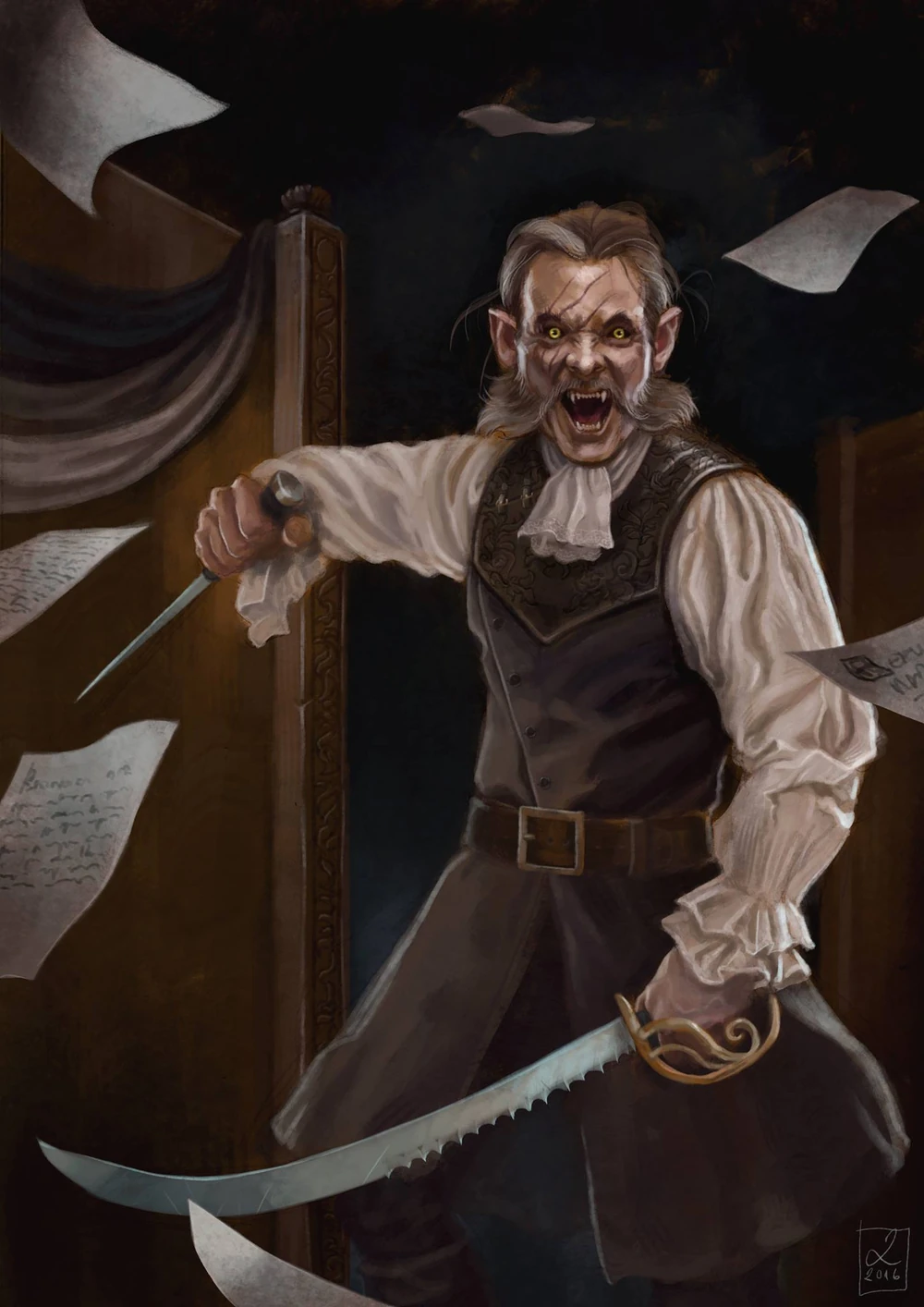
And finally—last to alight from the carriage, yet most distinguished of them all—a man likewise wigged, yet not with any common wig, but one glimmering with powder against which the sparkle of little diamond torches is set; wrapped in a black cloak; still in office commander of the entire Archroyal Air Fleet; adorned with those particular moustaches and beard that recall the stern virtues of Old Sigisland; and holding between his lips a porcelain pipe emblazoned with the arms of Sigisland and of his house.
They all enter the low, one-storeyed house of dark-red façade, adorned with ornaments in the shape of a stylised crown with torches, belonging to the worthy host, Master Tensen, village baker of more than a century’s standing in his line; and we follow them within, for the diary of Anton Zerlich has bequeathed to us a detailed account of this evening.
It is one of those houses common throughout the north of Tenelon and the south of Otterlon: reed-thatched, with a stepped—here even arched—gable, squat yet steadfast against the winds that scour these flats.
Since it is the custom, upon the Day of Family Honour, to come even uninvited, and for persons of all sorts to meet there, their arrival draws little notice from the other guests in Tensen’s house; attention is claimed rather by the sumptuous pastries the host has laid out, and by a great map of Neuland spread upon the table, over which the guests push little soldier-figurines, enacting wars of wood and tin with a zeal equal to that of real ones.
Three of the newcomers join the game: Austenberg—who, for reasons known only to himself, presents his name as “Mr. Pike”—Weiss, and Zerlich, who consents to command one of Labser’s fleets, such being the common fate of those who arrive last upon the Day of Family Honour. He does so with apparent reluctance, yet the Viscount assures him that the role suits him well enough: that Guntreland general who refused the royal crown of Neuland out of hatred for monarchy itself.
On the other side, Viscount Ester-Clausen and Wagner do not take part in the play of armies, but apply themselves industriously to food and drink, and to the historical disputations that accompany the campaign upon the board.
Wagner observes that the Guntreland nobleman, in dignity, rivals the Sigislander and commands a certain world-prestige; yet that the Guntreland commoner is the worst of all commoners. Ester-Clausen, for his part, delivers philosophical reflections upon the guilt of the Labserian legend in bringing about the present Revolution, all the while praising his hosts with ceremonious compliments of such gravity that no man could swear whether they were earnest or ironic.
This Wagner, indeed, speaks with some authority on the dignity of Guntreland nobility. His own blood-grandfather—the sixth Count of Herenburg—once, in a fit of wrath, hurled a servant into a brick-kiln because the fellow had washed his boots not with the costliest Tenelonian wine, as commanded, but had drunk the wine himself and cleaned the boots with some cheaper spirit.[1] And Wagner’s illegitimate father, the seventh Count, in the dead of winter, sent a peasant into an ice-choked river to fetch a duck which even the hunting dog refused to enter after, explaining, with the logic of “sound reason,” that a beast could not comprehend the necessity of obeying a count’s command, whereas a peasant might easily be persuaded—by threat of death.
As for Wagner’s companion, the Viscount’s father, Count Ester, had more than once placed the hat upon the King’s head[2]—an honour owed chiefly to the tireless social manoeuvres of the Viscount’s mother, Countess Clausen—while the Count himself, reckoned one of the greatest hunters in Guntreland and, by his own belief, in all mankind, cared far more for the royal forests than for the monarch’s wardrobe.
The war upon the board ends at last—with the title of Triumphator falling, as is customary, to Weiss—and this signals the beginning of stories from the real one.
All gather about a candle, above which hang round portraits of Crown Prince Ferdinand and Karolina-Luisa, and an oval likeness of Tensen’s ancestor; and the host, as every year, recounts with unconcealed pride the exploits of Old Tensen.
In the listeners’ minds there rises the figure of a great warrior in armour, musket in hand: charging enemy ranks; first upon the walls; even—so some are willing to believe—once infiltrating Labser’s own camp, disguised as a simple peasant whose father General Francis had shot for cowardice, and there misleading Labser with false intelligence about a forest stream, thereby causing that strategic error by which the Victor of Nine Battles met defeat at Ransburg. To some he appears almost in the very likeness of “Mr. Pike,” who loses no time in comparing these feats with his own adventures in the Guntreland counter-revolutionary army.
Tradition demands that, upon the family feast, memories be told of the war that united the continent and displayed its strength to the rest of the world; yet as wine and brandy flow, the tale follows Old Tensen home again.
He founded a family; raised the house where it still stands; established the trade by which it still endures.
One day, kneading bread, he saw a rider upon a black horse approaching, and recognised the village magistrate. The man wore a new cloak—blue instead of purple. Old Tensen ceased his labour, greeted him, and asked the reason.
“We recognise the Archking no longer. The South shall be independent! The Archroyal officials from Kellenburg have been thrown from the highest window of the Gerlava tower! I have come to call upon you also to raise the blue flag—the flag of the Free South—with the sail that symbolises our maritime calling, and the four towers of Gerlava, our greatest port.”
“The North gives us fur, iron, cannon, and fine cloth,” Old Tensen replied. “The South gives us the best ships, sails, and rope, pottery, wine, and olives. We are richer with eight provinces than with four.”
At these words the listeners drain their glasses with loud approval, and the magistrate in the story rides off muttering vague threats.
An hour later comes another rider, this time on a white horse, announcing that Stefan Birger is gathering the old Archroyal veterans to defend the unity of the Continent.
The mere mention of Stefan Birger heats the company further; for now the subject is not some distant war with far-off Guntrelanders—whom few of these Tenelonian peasants have ever met—but the rebellion that followed: separatists of the South against the unitarism founded by the First Archking; a war wherein the enemy was one’s neighbour from the same or the next village, one’s daily rival in market and tavern—against whom victory tastes incomparably sweeter.
“My grandfather used to say,” declares a man in a great black hat with a feather—who had been loudest of all in Archroyalist enthusiasm even during the game of Ferdinanding —“that old Alihard Aber of Zeindorf stopped his village, there beyond the hill among the separatists, from joining the rebellion, by slaughtering half his pigs and sheep the day before mobilisation, and on the very day roasting sausages and meat from morning till night and giving it all away free, so that every separatist stayed to eat instead of marching to war. And the next day Birger’s lads came and entered the village without resistance—for all the inhabitants were sleeping off their feast and drink.”
This tale—whose truth the hearers might accept or reject at their pleasure, even as we ourselves may—served as a signal that it was no longer solely the ancestor whose candle burned that was to be remembered; henceforth every man’s reminiscence from the Anti-Eugenic rising was welcome. The sole criterion was not truth, but vividness: that the greed, dishonour, and stupidity of the rebels be painted in colours as gaudy as possible. And the more the drink flowed, the more admirably these conditions were fulfilled.
Thus we hear of a certain Gerhard, a Tenelonian unionist, who, hidden all day in a tree behind the separatist ranks, shot their soldiers in the back one by one without being discovered; until at last, descending from his perch, he reproved them for marching so irregularly that he kept striking them instead of the Union troops—whereupon they accepted the advice as sound military wisdom and offered him a captaincy in their own company.
Ester-Clausen seems enchanted by such stories, and tells Wagner that the family legends of Tenelon are “the very essence of the old world worth fighting for.” Zerlich opposes him, insisting that only after the Reform, when Sigisland truly became a state just to all its inhabitants, did the Day of Family Honour attain its full meaning—for only then did all Sigislanders share wholly in the fruits of those struggles they celebrate.
Midway through one of his sentences, however, Weiss—who upon the board piles victory upon victory—bursts out with a shout: “Henscher is the worst of them all!” and, with a peal of laughter, drowns Zerlich’s discourse entirely.
Before Tensen, interrupted a dozen times, can finish the history of Old Tensen, Ester-Clausen takes the floor. In a voice heavy with ceremonial phrases he proclaims his love for old Sigisland and for the men who gather in Wagner’s “Estana,” while speaking with unconcealed contempt of the vulgar members of the high reformist bureaucracy with whom his diplomatic duties compel him to maintain daily relations—men whose chief crime, in short, is that they prefer working for their country to idling in languid sighs over its unhappy fate.
Zerlich retorts that the honour of national gentlemen consists in their right to speak their minds freely, not to play the hypocrite; and he asserts that Ester-Clausen knows full well the Karolinaluisist high bureaucracy will not change its opinion on intervention, nor will his attendance at their Family Day festivities sway them in the least; rather, that he cultivates them solely out of personal diplomacy, so that when the Guntreland kingdom collapses entirely he himself may assume Archroyalist citizenship and, through his acquaintances, secure the highest office possible.
To this insinuation Ester-Clausen makes no reply, saying only, with curious mildness, “that he loves Zerlich greatly, though Zerlich hates him.”
Then Sigismund rises, removing the porcelain pipe from his mouth, and addresses the gathering:
“Brothers, I see that you believe in the legends of your brave forefathers; you love the Archkingdom, Kellenburg, the Archqueen; you hate enemies and separatists. But I must tell you—Kellenburg is no longer what it once was. Beneath eight domes the people were united in an order made sacred by tradition and by time. Beneath ten domes all now compete to outstrip one another in rank; they employ deceits; they no longer regard one another as brethren, but as rivals.”
The host humours the Baron, whose views he already knows:
“It is true, my lord, bad times have come. My son is now in the military academy—wants to be an officer, imagine it! And I always told him we are simple folk, that such things are not for us. Where will he, a village child, be commanding drills, wearing epaulettes, attending officers’ balls—and forgetting his old parents who need help in the bakery?”
And Weiss adds his own judgement:
“There is more Sigisland here than in the capital.”
Then comes another of the venerable customs of the Day of Family Honour: that instructive and edifying game in which the host poses questions from the history of the Archkingdom and rewards with coin those who first answer correctly.
To the embarrassment of the rest, the foreigner Wagner displays a knowledge superior to all others, and Tensen promises him a rich prize which, alas, he cannot pay at once. Yet Alexander Weiss will not concede the matter; he is persuaded that he knows a history truer than that recorded in the Archroyal Encyclopaedia—the recognised supreme judge of the contest—and, moreover, that he knows answers not only from the past but from the future.
“Did you know,” asks the man with the hat, calmly smoking his pipe, “that Ferdinand the First once said that if he had a hundred thousand soldiers from Ratedorf he would conquer the whole world?”
“Indeed he did,” Weiss replies. “And by certain calculations of mine, the ancient prophecy of the heavenly warriors who shall defeat the evil Cloud-King, after which the power of the Archkingdom shall be eternal and boundless, speaks precisely of the Tenelonians—whose bold sailors are known to hunt the albatross, that mighty sea-bird, king of the clouds, for sport and without effort. And do you know what they shall fly with in that celestial war?”
He smiles, pleased with his own discoveries, and after further teasing—“What do you think?”—answers himself:
“With the Accursed Balloon, which did not fall with the Armada precisely so that the prophecy might be fulfilled and that these warriors of destiny might ride upon it. It has all been written long ago; only men do not know and will not read!”
He then declares that he and Ester-Clausen shall stand upon that balloon’s deck, while Zerlich too will have a role—but on earth, not in heaven. All this Weiss has deduced by interpreting Balster’s verses and much besides, holding Balster—who, through the menace of the kraken, foretold the exact year of Sigisland’s curse—to be a veritable prophet, or something very near it.
At that moment a brass band arrives at Tensen’s house, and merry folk songs resound; and Weiss, even more than with his historical erudition, now displays his mastery not only of the theory of Tenelonian folk music but of the practice of the dance itself.
When that full-blooded, jesting, almost fairground Tenelonian music and dance had wholly conquered the house—when boots thudded upon the planks, when laughter rose in gusts like wind in the reeds, and when even the most solemn faces relaxed into the red cheer of wine—the loud man with the hat at last approached Sigismund and quietly drew him aside.
“You speak of reaction, of struggle,” he said. “All here are brave men and faithful to the Archqueen. But they enact their courage in tales of their ancestors’ deeds, and their loyalty in the singing of hymns. I am Mister Remben, a merchant from Zayle. I know who you are, and I wish to take you where men are ready for a real fight. But you must come alone—and now at once. Your friends may wait for you here, where, I am certain, they have fitted in excellently.”
And so Sigismund went with him.
They visited the Archroyal stables, which labour day and night without rest, and there borrowed two powerful chestnut horses. Then, in silence—Remben riding ahead of the Baron—they set out along a narrow track across moonlit hills and sandy dunes, the only sounds the muffled beat of hooves and the occasional sigh of the night wind. Thus they rode for some three-quarters of an hour.
At last they reached a solitary windmill, from whose windows a subdued candlelight flickered like a conspirator’s signal.
“We have arrived,” declared the man with the hat, reining in his horse.
Baron von Austenberg dismounted as well. After tethering the horses to the wooden fence before the lonely structure, he followed Mister Remben through a heavy wooden door beneath the enormous wings of the mill.
Inside, a considerable surprise awaited him.
In the circular chamber—bounded by somewhat rough yet immaculately white walls—stood a simple semicircular wooden table, with a matching bench curving around it. Upon this bench sat men clad in traditional southern cloaks and broad hats, some of a captain’s cut, others plainly civilian. Numerous candles burned upon the table, beside bottles of wine and wooden cups; and the absence of a Ferdinanding board immediately made clear to the Baron that this was no miller’s family celebration—though he had half suspected that the talk of struggle might be merely a lure to draw him into yet another festivity—but rather, as Remben had promised, something of greater consequence.
As though they had been awaiting his arrival, they rose one by one and introduced themselves, each lifting his hat with theatrical gravity:
“Staz, vintner, proprietor of a winery.”
“Kauer, potter and manufacturer.”
“Rauz, carpenter, representative of the craftsmen of Gerlava.”
“Bunscher, sailmaker.”
“Ezler, captain.”
“Furensen, marquis—and captain.”
“Vorianburg, sailmaker.”
“Mill, flour manufacturer, owner of this windmill.”
“Gerhard-Rau, ship’s physician.”
History records these nine names.
“Baron Sigismund von Austenberg, commander of the Archroyal Air Fleet,” replied the Baron with equal theatricality.
Mister Remben took his seat at the table and gestured for Sigismund to sit beside him.
“We have gathered here,” he began, “because the state of the world can no longer be endured.
“And once—once it was not so.”
The events of the Windrel Mill have come down to us through the memoirs of Austenberg himself; and so we shall let the Purple Baron speak in his own voice:
“By candlelight that adorned company had assembled—the very cream of the traditional southern elite. When the last of them had finished his introduction, they fell into silence for almost a full minute, doing nothing but drink their wine; and one could see how they savoured it with something close to reverence, as though it were not a beverage but a sacrament—the ancient produce of their own soil.
Then, one by one, they began to speak.
They spoke chiefly of their hardships in life—so far as Southern pride permitted hardship to be confessed at all.
The vintner was ruined, for the fashions drifting down from the North now prescribed tropical fruit-juices, imported from the Archipelagic Confederation, as accompaniment to every meal. ‘Why,’ he asked, ‘should Sigislanders be forced to swallow foreign fruits from distant islands instead of grapes from their own sacred earth?’
Captain Ezler, of an old seafaring house—whose forefathers had commanded Francis’s ships when they sailed against Labser—complained that his son now served as first officer under the son of a former serf.
The other captain, young and ardent Furensen, had inherited two castles and broad lands; yet because he refused to become a farmer himself and chose instead the honourable southern life of a mariner, as taught him by his father-in-law, he had been compelled to sell those lands at auction to former peasants. One castle too he sold—though not to peasants and at a fair price—to the Crown, which converted it into an orphanage.
The sailmakers lamented that the funds Ferdinand had once destined for the navy had been diverted by the Archqueen toward schools, libraries, and hospitals.
The miller protested that the new laws of categorisation had forced him either to sell the windmills his family had built to their former mill-hands or else employ them all at high wages; so that those who had once depended upon him became first his well-paid workforce and then, when he could no longer sustain such wages and was compelled to sell, his competitors.
The carpenter and the potter bewailed the compulsory state associations which replaced the old guilds, whereby every man categorised as an artisan must be given all the secrets of the craft—so that former apprentices now sprang up as masters in their own right. And the secrets Ferdinand had once refrained from placing in his Encyclopaedia, out of respect for the guilds, were now inserted and made accessible to all mankind. Worse still, vulgar industrialists from the increasingly mechanised North devoured their trade day by day.
At last Mister Remben spoke most openly:
‘We are all convinced that the cause of our miseries lies in the so-called Reform, which has separated father from son, servant from master, and overturned every thing from its natural station. Were the crown upon your head, we are certain it would not be so.’
Though I shared his view of the Reform’s consequences, I considered it my duty to warn him of the inadmissibility of such remarks concerning the Crown, for in them lay the very seed of treason.
‘One crown of eight torches is borne by Karolina-Louise, the Archqueen. Any other who set that crown upon his head would be called usurper and traitor—and I would sooner lose my head than earn that name.’
Then a sailmaker rose and, looking me straight in the eye, asked quietly:
‘And who, Baron Austenberg, spoke of the crown of torches?’
At that moment I noticed the shadows of these men playing upon the candlelit wall; and it seemed to me that their silhouettes were none other than those same Anti-Eugenites who had been drowned in the Bay of Gerlava and buried in the fields of Gerd—men who, after one hundred and eighty-five years beneath water and earth, had risen again that very night in the windmill, to continue what had once been stopped by force. Even the crickets outside seemed to chirp a single word: Treason.
‘Now I understand,’ said I. ‘You expect me—whose Erchroyalist nobility is two centuries old, whose ancestor stood beside the Founder himself—to rise against the purple banner with crown and torches and become king of your “Free South,” or whatever you call it?’
Remben calmly drained his glass.
‘That is precisely what I expect. The Archrealm you speak of no longer exists. It no longer fulfils the obligations of the Congress that created it. You owe it no loyalty.’
‘Have you no honour?’ I asked. ‘You swore to Ferdinand the First—to him whose guns saved your colonies from Labser.’
‘We consider that oath void since the year Seventeen, when Ferdinand died without heir,’ he replied, invoking the old Anti-Eugenite sophistry, abusing the Founder’s self-sacrifice. ‘The adoption of von Liswerburg[3] followed northern custom only; without ritual, without the placing of the cap by three captains. For us it holds no validity. Your Archkings may call Ferdinand their ancestor; for us he is not.’
He smiled warmly as he said it, and I was forced to grant him a certain consistency, though as an Erchroyalist I could not admit that local customs might annul the Founder’s will.
‘Your nobility your Archqueen has abolished,’ another added. ‘She has levelled you with woodcutters and butchers. Ferdinand the Second sent the whole of Sigisland to die for Guntreland; Karolina will not send a single balloon against Henscher. The North laughs at you. They greet you to your face and mock you behind your back. They even fire upon you in the Archqueen’s name.’
Then Remben again:
‘If the old Archrealm is dead—and you know in your heart that it is—we offer you the chance to build with us a new bastion of Reaction to take its place.’
I pondered this.
Why me, I asked, born and bred in the North?
They answered that only thus could they avoid rivalry among themselves; and that they respected my chivalric and reactionary ideals, my leadership, my courage, and the happy fact that my ancestor had not taken part in suppressing the First Rising.
I warned them that this meant not merely destroying the Archrealm but the entire Congressional order. They replied that the order had already exploded, that a system which could not preserve its founding values deserved replacement.
‘You may be the Ferdinand the First of a new age,’ they said, ‘the founder of a new world Reaction.’
At length I declared their arguments irresistible, and that duty to humanity and my own name compelled me to accept the crown offered to me. I even jested that I should not refuse a crown and be compared with that pirate Labser.
At the name they struck the table with their fists, as Southerners do to show a name unworthy of speech.
‘Long live King Sigismund Austenberg the Reactionary, King of the Free South and founder of the world Reaction!’ cried Remben, and all repeated it.
They showed me a document—one hundred notable men from the four southern provinces, signed and sealed, ready to rise at once.
At last they demanded I swear and sign.
I answered that I would swear as king before army and people; but now would pledge only not to betray them.
So I swore—and signed.
Then, with visible sorrow and no small struggle against tears, I removed from my coat the purple ribbon bearing the medallion of Crown and Torches.”
On the following morning, before the windmill, blue banners bearing the tower and the sail were unfurled. A great multitude had gathered—villagers of every category from all the surrounding settlements: some armed with firearms, others with cold steel; some mounted, others on foot. Their wives too were there, come to see them off to war. All waited with impatience for their promised king, who—though himself of northern blood—was to lead the Southerners into freedom and independence and restore their ancient traditions.
The nine separatist leaders received him at the head of the people.
And precisely at ten o’clock, as announced, he arrived.
Mounted on horseback, clad in metal armour, with flawless moustaches and beard and a proud expression upon his face, he rode forth; behind him came the drummers, and behind them an entire regiment of infantry, all in purple uniforms. The hated colour sowed momentary uncertainty among the separatists—but were not their own sons and brothers clad in purple when they served? Could one expect a uniform to change colour in a single night? And above all, the sheer number of soldiers following Austenberg filled them with confidence.
Cries of “Long live the King!” rang out. Austenberg halted and raised his hand, signalling that he wished to speak to his new subjects.
“You have called upon me to restore your traditions,” he proclaimed in a solemn voice, as army and people fell into formation and several men raised the blue banner upon the windmill itself, conscious of its meaning as the birthplace of the Second Rising. “And I shall show you at once that I intend to keep my promise—that this fair land shall forever be a bastion of Reaction. A bastion of Reaction in which treason shall always be punished by death. In the name of the first among the rulers of the world, Her Majesty Archqueen Karolina-Louise —aim and fire!”
At these words the purple-clad soldiers levelled their muskets at the separatist leaders standing before the people; moments later they discharged them. Gunfire thundered, cries and screams rose; the leaders fell, struck through the chest. The soldiers then shot down the blue-clad riders, then fired upon the hostile infantry and the fleeing crowd amid the general chaos. They tore down the rebel banner from the windmill and raised in its place the Erchroyalist standard.
“Thus ended these separatists,” concludes the recorded account of the Baron of Austenberg, “who in the madness of treason imagined that a descendant of the Purple Baron of Hettin would lead them in their traitorous enterprise; who trusted my word, not knowing that an honourable man is not bound by a promise given to traitors. And thus may all end who would seek to extinguish even one of the torches of Ferdinand, First Archking.”
Having spoken thus, the Baron drew from his collar the purple ribbon he had worn hidden beneath his uniform, entered the windmill, found upon the table the untouched paper he had signed the previous night, and burned it before witnesses.
And with this act we begin the tale of that event whose immediate prelude was the famous night in the Windrel Windmill.
[1] This case attracted a lot of attention in its time, since king Alfons II convicted the cruel count to wear a red glove on the hand that he used to push the servant in the furnace. This punishment for the murder was seen by some aristocrats of that period as royal meddling into their ancient right of deciding between life and death of their subjects.
[2] This is in reference to the monarchist ritual of rising and dressing of a ruler, established by the Sigislandian arch-king Ferdinand II and later adopted by all other monarchist countries, which implied that the most notable individuals of the monarchy helped the monarch dress up. During this ritual, individuals that would dress the king in his shirt or put his hat on his head were considered to be the most honored. During the reform that abolished the hereditary estates and replaced it with categories, arch-queen Karolina-Louise, among other things, abolished this ritual in her country, but it continued on in other monarchies.
[3] [3] This is in reference to Eugen, the second Archking of Sigisland (who ruled from the congressional year 17-39), born 26 years before the Congress (year 212 b.R.) to a noble Evenlonian family of the name Von Lisverburg. When alliance between Sigislandian states was forged, he served as a personal adjutant to general Francis, and distinguished himself in war with his courage. After Ferdinand of Othelon was proclaimed Archking, Eugen von Livserburg was proclaimed First Arch-chancellor. Ferdinand’s legislation titled ‘On inheritance’ from the year 10 (190 b.R.) made him an heir and Ferdinand’s adopted son. As we can see, part of southern Sigislandians, called Anti-Eugenites, disputed this adoption, and that served as a formal reason for the grand rebellion of year 17-19, quelled with force by Eugen with the help of armies of all congressional states, after which the four towers in Gerlawa were burned to the ground on his orders. Since then, the population of South Sigisland is split between the Unionist, who support the unity of the Archkingdom, and Separatists, who support the independence of four southern provinces. During the reign of Eugen, the Triumphal gate, as well as the Coronation Cathedral were built in Ferdinandshafen. All subsequent archkings, ending with Karolina-Louise, are his direct descendants.